
Energy & Carbon Reduction
Nano Black-Body Radiation Coating HT-Series
A dense, homogeneous ceramic coating produced by nano composite-phase sintering, with full-band emissivity ≥ 0.96 across 2.5–16μm and targeted emission-peak enhancement at 3.3μm and 7.6μm — the characteristic absorption bands of natural gas. Applied to burner heads and gas-piping interiors, it continuously irradiates the passing gas stream with the specific wavelengths it absorbs most efficiently, raising molecular internal energy, lowering the activation barrier and delivering gas savings of 5–12% alongside a 30–50% reduction in flue-gas CO.
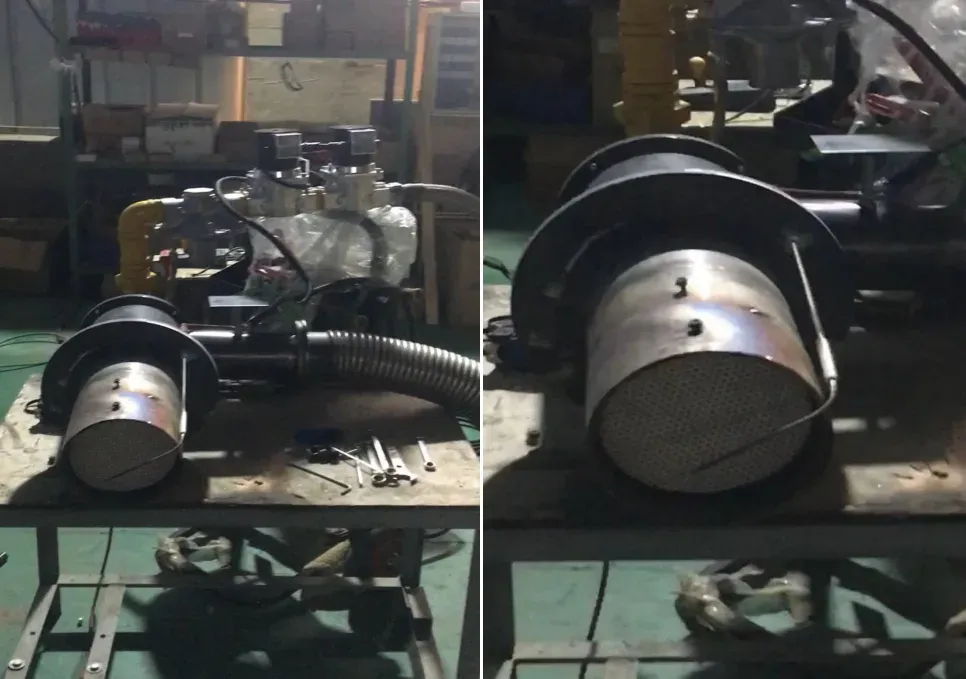
Overview
Natural gas molecules absorb infrared radiation selectively and strongly at two well-defined spectral windows that correspond to their fundamental vibrational modes: the C-H stretching vibration near 3.3μm and the C-H bending vibration near 7.6μm. Radiation falling within these windows is absorbed directly by the gas, converting to molecular internal energy and effectively lowering the activation barrier to combustion. Radiation outside these windows either passes through the gas transparently or heats the surrounding air — contributing nothing to ignition efficiency or combustion rate. This spectral selectivity is the design basis for the HT-Series coating. Produced by a nano composite-phase sintering process, the coating places enhanced emission peaks precisely at 3.3μm and 7.6μm while maintaining a full-band emissivity of ≥ 0.96 across 2.5–16μm — substantially higher than conventional refractory surfaces, uncoated metal or standard high-temperature paints. Applied to burner heads and gas-piping interiors, it functions as a continuous molecular preheater: as gas flows past the coated surface, it is irradiated with the wavelengths it absorbs most efficiently before entering the combustion chamber, arriving with higher internal energy and a lower ignition threshold.
The combustion performance improvements that follow are consistent across installations and measurable by standard instrumentation. At matched load conditions, gas savings of 5–12% have been recorded. Flue-gas CO falls 30–50%, the most direct indicator of improved combustion completeness — more of the carbon in the fuel oxidizes fully to CO₂ rather than stopping at CO. NOx shows no notable increase; because the activation-energy reduction allows complete combustion at a lower peak temperature, the thermal NOx formation rate is actually suppressed rather than amplified. Furnace-wall temperatures at representative measurement points typically fall 10–20℃, reflecting the shift of energy from structural heat absorption to productive load heating, and the flame-stability range widens, improving turndown flexibility and reducing the risk of combustion instability at low load.
The coating's durability profile matches its spectral performance. Solid content ≥ 65% ensures the film is dense and well-bonded at the recommended 80–150μm application thickness, without the porosity and adhesion weaknesses that affect lower-solid-content coatings under thermal cycling. The long-term service temperature of 850℃ and peak tolerance of 1050℃ cover the full operating range of industrial gas burners. Thermal-shock cycling tests between 800℃ and 25℃ — simulating the repeated start-stop cycles experienced by industrial burners — have been conducted to ≥ 50 cycles without delamination or cracking, confirming that the coating will remain intact and optically active through normal equipment maintenance intervals.
Application is by conventional spray equipment; a skilled technician can coat a set of burner heads within a standard maintenance window without any structural disassembly or modification of the burner or piping. For facilities that have already made primary investments in burner retrofits, low-NOx burners or other combustion improvements, the HT-Series coating is a cost-effective second-layer optimisation — additive to the primary gains, deployable without disturbing existing hardware, and recoverable within a short operating period. The ability to stack it with other Langfu technologies makes it a natural complement to a broader energy-saving programme.
Key advantages
- Spectrally targeted emission peaks at 3.3μm (C-H stretch) and 7.6μm (C-H bend) — natural gas's two primary absorption windows
- Full-band emissivity ≥ 0.96 (2.5–16μm): far higher radiative conversion than conventional refractory surfaces or bare metal
- Molecular pre-activation reduces ignition delay, widens the flame-stability envelope, and delivers 30–50% lower flue-gas CO with no notable increase in NOx
- Furnace wall temperature typically falls 10–20℃ as more energy transfers to the load and less escapes to the structure
- Spray-applied at 80–150μm: fits within a routine maintenance window, no structural modification to burner or piping required
- Long-term service at 850℃ (peak 1050℃); thermal-shock tested 800↔25℃ for ≥ 50 cycles without delamination or cracking
More in this category