
Energy & Carbon Reduction
Gas Kiln Burner Retrofit
Custom burner-system retrofits for gas kilns in ceramics, glass, metallurgy and refractory manufacturing, grounded in rigorous on-site diagnosis rather than standard templates. By redesigning gas-air mixing geometry, exit flow profiles and ignition characteristics to match each kiln's actual operating envelope, the retrofit simultaneously achieves a gas saving exceeding 10%, measurable improvement in furnace temperature uniformity, and reduced NOx generation — three gains from a single engineering intervention.
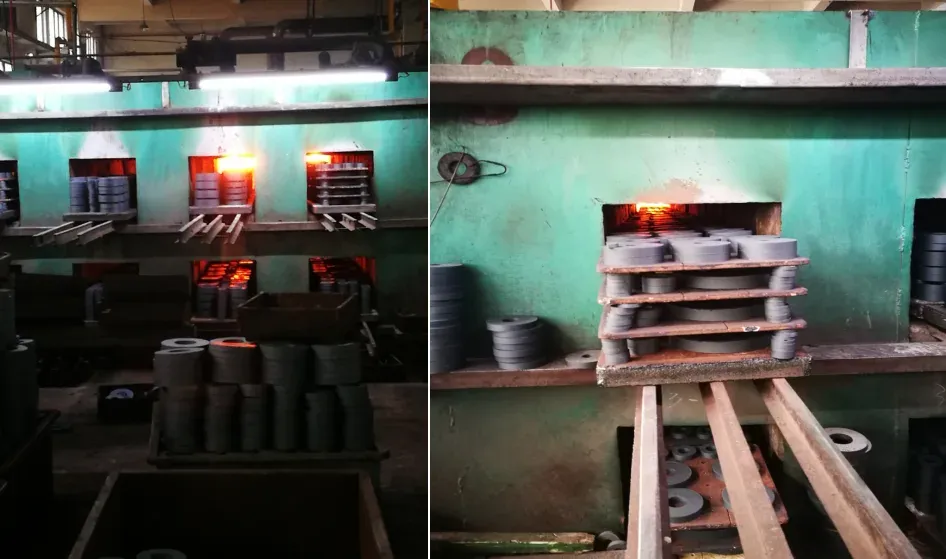
Overview
The burner is the single highest-leverage component in any kiln's energy balance. Many industrial kilns operating today carry burner systems whose geometry was fixed decades ago, sized for fuel compositions, air supply pressures and production throughputs that no longer match the plant's current reality. The mismatch manifests in ways that are visible in both the production data and the fuel bill: excessive cross-section temperature differentials that push reject rates up, oxidation-scale formation on heat-treated parts that shortens tool life, NOx readings that persistently exceed permit limits, and fuel consumption that stubbornly overshoots the theoretical target. Adjusting operating parameters around a poorly matched burner reaches its limits quickly; the durable solution is to rethink the burner itself.
Before any hardware proposal is made, Langfu's engineering team conducts a systematic on-site diagnosis. The diagnostic programme measures gas supply pressure and composition, combustion-air volume and fan curve, furnace temperature distribution across multiple cross-sectional points at multiple firing stages, and the existing burners' actual flow characteristics under the current operating conditions. This body of data does not merely describe symptoms — it locates the specific structural mismatches responsible for them, whether that is an under-swirled mixing chamber, an oversized exit orifice creating excessive standoff, or an air-to-fuel ratio calibration that drifts under variable gas supply pressure. The retrofit design addresses those root causes directly, with custom mixing geometry, swirl ratio and exit cone angle calculated for the kiln's specific operating envelope. The outcome is a more ordered and contained flame, a heat-release profile matched to the furnace cross-section, and a temperature distribution that is substantially more uniform from side to side and from top to bottom.
Temperature uniformity is where the engineering gains translate into the most tangible commercial return. In ceramics production, more uniform firing temperature raises first-pass yield and reduces colour and dimensional variation between pieces in the same batch. In glassware, thermal-stress-induced defects — warping, cracking, internal stress — decline in proportion to the reduction in temperature differential. In metallurgical heat treatment, batch hardness variation narrows and oxidation-scale formation is suppressed, reducing material loss and downstream finishing cost. Simultaneously, the reduction in local peak temperatures within the combustion zone — an inevitable consequence of better-distributed heat release — directly cuts thermal NOx formation, since NOx generation rate is exponentially sensitive to temperature peaks. A single retrofit thus delivers energy savings, quality improvement and emissions compliance as concurrent, not competing, outcomes.
Typical projects achieve a gas reduction exceeding 10%, a figure verified by acceptance testing conducted with calibrated measurement equipment once the retrofit is commissioned. The physical work is structured to fit within a standard scheduled maintenance window, requiring no additional unplanned shutdown. Langfu provides commissioning support, post-retrofit measurement and long-term technical assistance to ensure performance is sustained throughout the equipment's operating life.
The engineering core of the retrofit is the pairing of nano thermal-boost technology with swirl-mixing. A mixing air-disc at the burner inlet intensifies the initial blend of gas and combustion air, a catalytic plate lowers the ignition threshold, and a thermal booster raises the temperature at the flame root; combined with a reorganised staged mixing chamber, adjustable swirl vanes, a multi-orifice nozzle array and a flame-stabilizing disc, flame temperature rises by +60–200℃ with a more concentrated and ordered heat-release profile. Measured gas savings vary by furnace type — kiln projects typically reach 7–14%, boilers around 10%. The approach has cleared a formal novelty search by the MOST Southwest Information Centre (ref. J20265001269178473): after querying more than thirty domestic and international databases, the centre concluded “no identical prior art exists at home or abroad — the technology is novel”, giving the retrofit independent third-party validation of its originality.
Key advantages
- Thorough on-site diagnosis before any hardware proposal: gas pressure, air volume, temperature mapping and burner flow characterization
- Custom mixing geometry eliminates dead zones and turbulent dissipation in the gas-air mixing chamber
- Redesigned exit flow profile and ignition geometry: more ordered flame, reduced ignition delay, wider stable-operation envelope
- Significantly improved cross-section temperature uniformity — direct improvement in product first-pass yield and batch consistency
- Lower local temperature peaks in the combustion zone suppress thermal NOx formation, satisfying tightening emissions standards as a co-benefit
- Retrofit execution fits within a scheduled maintenance window: no disruption to the production plan
- Nano thermal-boost technology paired with swirl-mixing: a mixing air-disc, catalytic plate and thermal booster reconstruct the combustion organization
- Staged mixing chamber, adjustable swirl vanes, multi-orifice nozzle array and a flame-stabilizing disc together raise flame temperature by +60–200℃
- Verified by a novelty-search report from the MOST Southwest Information Centre — concluding “no identical prior art found at home or abroad — novel” (ref. J20265001269178473)
More in this category