
Energy & Carbon Reduction
Low-NOx Energy-Saving Burner
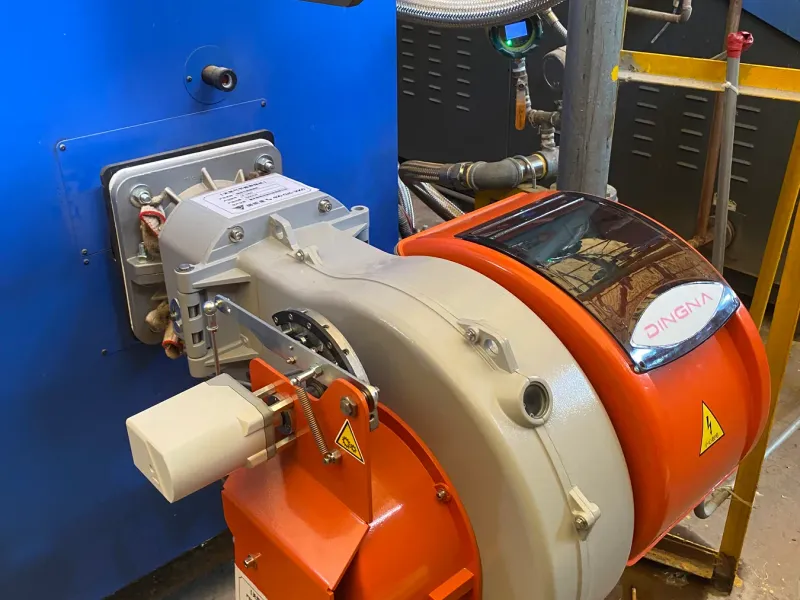
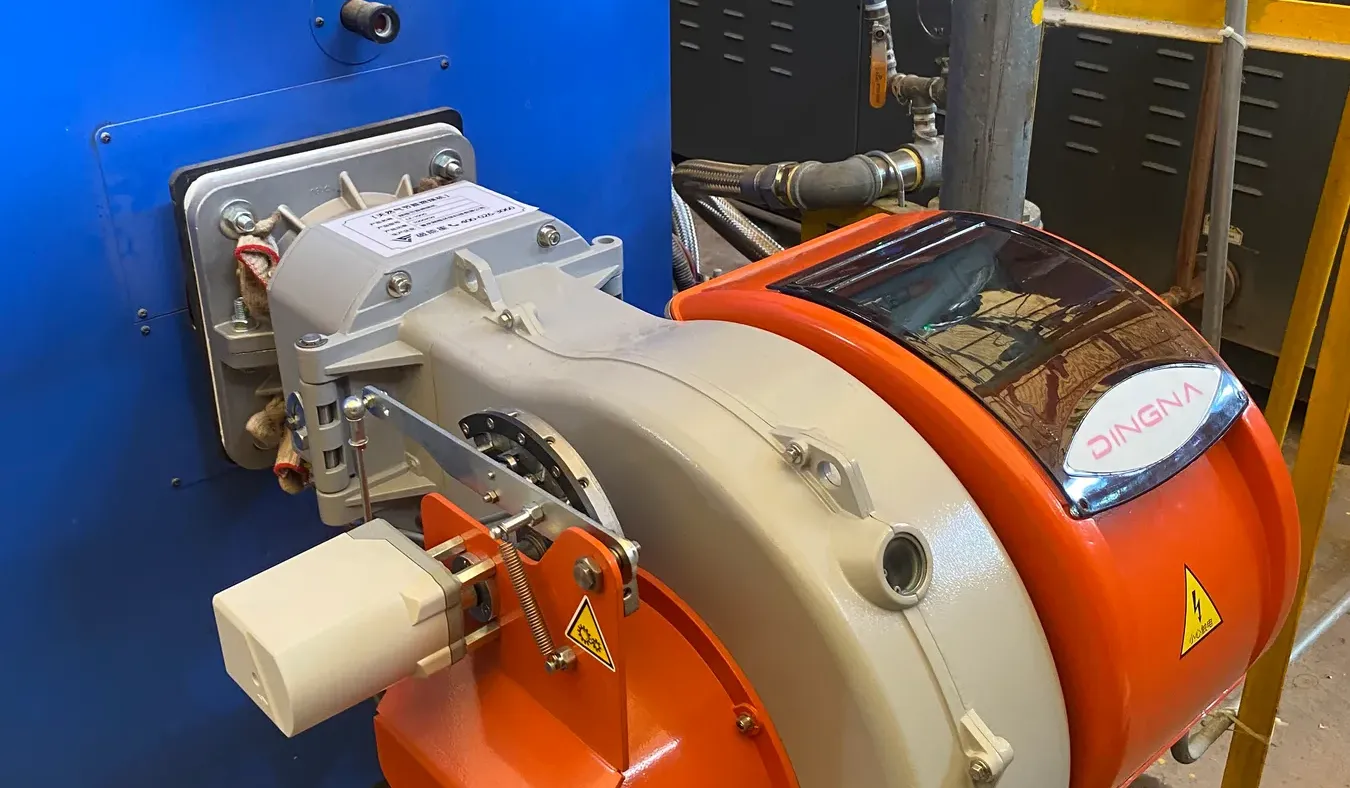
Langfu's in-house low-NOx energy-saving burner integrates staged combustion and internal flue-gas recirculation to attack thermal NOx formation on two fronts simultaneously — staggering the peak heat-release event in space and time, then diluting residual oxygen and damping temperature spikes with recirculated flue gas. The result is NOx emissions far below national standards, with high thermal efficiency and wide-range load stability maintained in full, including at partial load.
Overview
Industrial combustion produces nitrogen oxides through mechanisms that are well understood but not easily neutralised without a deliberate design response. The dominant pathway in gas-fired equipment is thermal NOx: at flame temperatures above roughly 1300℃, atmospheric nitrogen and oxygen combine directly at a rate that increases exponentially with temperature, meaning small reductions in peak flame temperature produce disproportionately large reductions in NOx output. Conventional single-stage burners release the entire fuel charge in a single combustion event, creating a high-intensity, high-temperature reaction zone that is inherently prone to thermal NOx formation. Langfu's low-NOx burner dismantles this single-event structure through staged combustion: primary combustion air — intentionally sub-stoichiometric — is introduced with the gas in the first zone, supporting a lower-intensity, fuel-rich initial reaction that ignites reliably but stays below the critical temperature threshold. Secondary air is introduced further downstream in a second zone, completing the oxidation at a temperature level that has already dropped from the primary peak. The staggering of heat release across two zones in both space and time keeps local temperatures below the regime of rapid thermal NOx formation throughout the combustion process.
A second, complementary mechanism — internal flue-gas recirculation — draws a controlled fraction of already-cooled combustion products back to the flame root through an internal passage. Mixing this cooled gas with the incoming fuel-air charge has three simultaneous effects: it dilutes the local oxygen concentration in the primary zone, reducing the reaction intensity; it lowers the adiabatic flame temperature of the mixture entering the first stage; and it adds thermal inertia that buffers against NOx concentration spikes during load transients, when rapid changes in firing rate can temporarily push combustion conditions outside the steady-state operating point. The combined action of staged combustion and flue-gas recirculation pushes NOx to levels far below current national environmental standards, with comfortable headroom for the stricter provincial and municipal emission limits that are becoming standard across Chinese industrial zones.
Neither mechanism compromises thermal performance. Staged heat release and the improved flow patterns created by internal recirculation actually improve the uniformity of heat transfer to the boiler heating surface in many applications, offsetting any minor efficiency penalty from the more complex flow path. Load modulation capability is broad, and the low-NOx operating mode is maintained throughout the load range rather than degrading at partial load — a characteristic that matters significantly for industrial boilers operating on variable demand profiles, where part-load conditions are the norm rather than the exception.
The burner is packaged in a compact modular housing whose mounting interface matches the connection standard of mainstream industrial boilers, making it a drop-in replacement for existing units with no additional mechanical work on the boiler body. Field experience spans industrial boilers, hot-blast stoves and process heating equipment. Acceptance testing in each case has confirmed simultaneous and independent improvement in both fuel efficiency and NOx emissions, establishing the burner as the central hardware component of Langfu's integrated clean-combustion offering.
The performance is backed by independent third-party testing. Guangdong Baotong (a CMA- and CNAS-accredited laboratory) compared the low-NOx energy-saving burner against a conventional unit under matched operating conditions: combustion completeness rose from 88% to 96%, natural-gas consumption per tonne of steam fell from 75 m³ to 69 m³ (about an 8% reduction), and overall pollutant emissions dropped by roughly 15%, with a visibly whiter, more complete flame. The burner is offered in five head sizes by thermal rating — 230#, 320#, 450#, 630# and 1000# (calibrated in KW and m³/h) — so it can be sized precisely to boilers, hot-blast stoves and heating equipment of different capacities, avoiding the efficiency penalty of an over- or under-matched unit.
Key advantages
- Staged combustion delivers primary and secondary air separately, staggering peak heat-release in both space and time to suppress thermal NOx at source
- Internal flue-gas recirculation dilutes local oxygen concentration and damps peak flame temperature, adding a second NOx-reduction buffer active during load transients
- NOx emissions far below national standards, with headroom to satisfy the stricter regional limits increasingly imposed in Chinese industrial zones
- High thermal efficiency maintained across the full load range — combustion uniformity may actually improve versus the replaced unit
- Compact modular housing, compatible with mainstream industrial boiler interfaces: drop-in replacement with no additional boiler-body machining
- Wide load-modulation range; low-NOx character preserved at partial load, not only at rated conditions
- Independently tested by Guangdong Baotong (CMA / CNAS): combustion completeness 96% versus 88% for the reference unit, gas per tonne of steam 69 m³ versus 75 m³ (−8%), and pollutant emissions down about 15%
- Burner heads span five sizes — 230# / 320# / 450# / 630# / 1000# (rated in KW and m³/h) — matched to boilers and heat loads of different capacities
More in this category