
Energy & Carbon Reduction
Natural Gas Rapid Catalytic Combustion
A gas-solid catalytic deep-oxidation process in which natural gas molecules adsorb onto a precious-metal-active honeycomb catalyst surface and undergo near-complete oxidation at far lower activation energy than conventional flame combustion. The energy released exits almost entirely as mid-infrared radiation — wavelengths that solid materials absorb readily — bypassing the visible-light losses inherent in open-flame combustion. Daily-use ceramic kilns averaged 19.6% gas savings in field measurements; a 1700℃ high-temperature ceramic kiln more than doubled its heat-up rate.
Overview
Conventional premixed gas combustion is a homogeneous gas-phase reaction that sustains itself at temperatures typically above 1200℃ in industrial equipment. A well-established and often-overlooked consequence of this high-temperature regime is that a significant share of the total energy released is emitted as visible light — wavelengths in the 0.4–0.7μm range. Most solid industrial materials — ceramic greenware, refractory bricks, aluminium billets, steel forgings — absorb visible light very poorly. The bulk of this visible-light energy is reflected from furnace walls or absorbed by the refractory lining and then re-emitted as low-grade heat, contributing to structural temperature rise and conductive losses rather than to heating the charge. The effective energy utilisation rate of open-flame combustion is therefore substantially lower than the fuel's calorific value would suggest. Catalytic combustion replaces this homogeneous process entirely. Natural gas molecules flowing through the honeycomb catalyst bed adsorb onto the precious-metal active sites and undergo deep oxidation through a surface reaction pathway whose activation energy is far lower than the gas-phase ignition threshold. The reaction enthalpy exits as mid-infrared thermal radiation — in the 2–16μm range — which solid industrial materials absorb with high efficiency. The energy transfer path from flame to workpiece is shortened and direct, with the intermediate step of heating refractory walls and re-emitting largely bypassed.
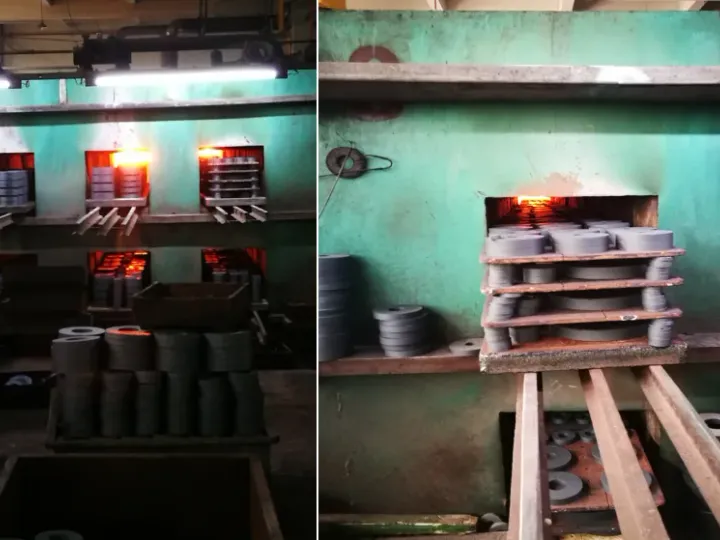
Three quantifiable and inter-related process gains result from this mechanism. The first is fuel savings: replacing visible-light and high-temperature convective transfer with direct infrared irradiation allows the same heating outcome to be achieved with a lower gas input rate. Daily-use ceramic kilns are the best-documented application, with field measurements returning an average gas saving of 19.6%. The second gain is faster heat-up: because infrared radiation penetrates directly into the body of the material being heated rather than relying on conduction inward from a hot gas stream, the effective heat transfer coefficient is higher and temperature rise in the charge responds more quickly to the furnace input. A 1700℃ high-temperature ceramic kiln more than doubled its ramp rate in field installation; the compressed firing cycle not only reduces energy per batch but also increases kiln throughput, a combined improvement that multiplies the economic value of the technology. The third gain is temperature uniformity: catalytic surface reaction distributes heat release across the physical area of the catalyst bed, which maps more evenly onto the furnace cross-section than a concentrated gas-phase flame core. Cross-section temperature differentials narrow significantly, reducing the thermal-stress-induced defect rates that are a persistent quality challenge in ceramics, refractory and glass firing.
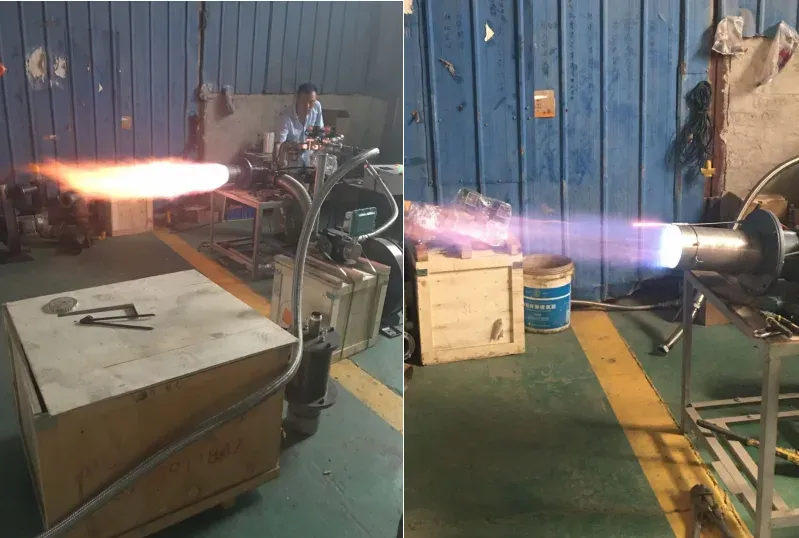
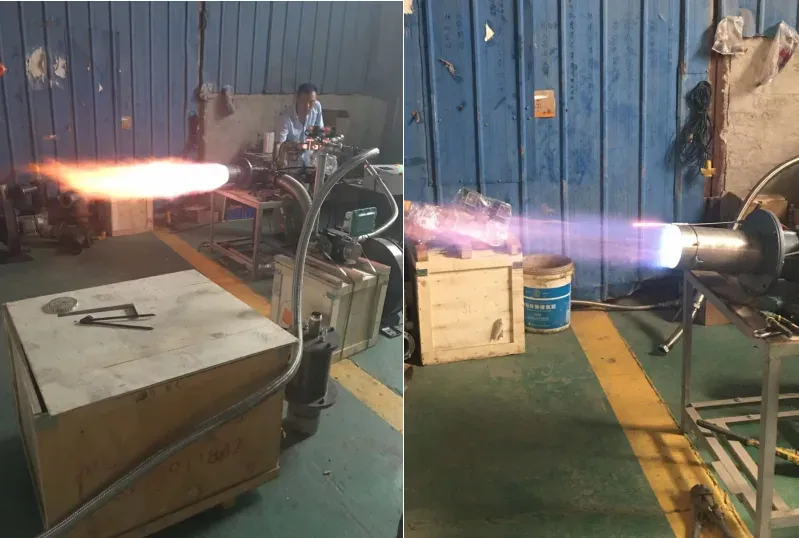
The visual character of catalytic combustion is both distinctive and diagnostic of its performance. The flame is transparent — absent the yellow-orange luminosity that signals incandescent soot or incomplete combustion — with a faint violet outer cone that marks the edge of the near-complete deep-oxidation zone. Flue-gas composition analysis confirms what the eye observes: CO is present at levels near the instrument detection limit, unburned hydrocarbons approach zero, and NOx is reduced compared with conventional open-flame combustion at equivalent thermal output, because the peak reaction temperature is lower. Catalytic combustion is simultaneously the highest-efficiency and lowest-emission combustion mode available for natural gas — the two objectives that are in tension in many other combustion technologies here reinforce each other.
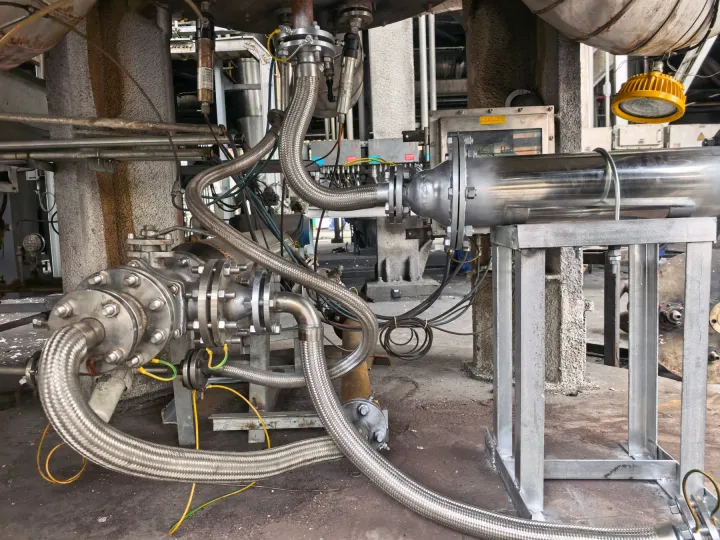
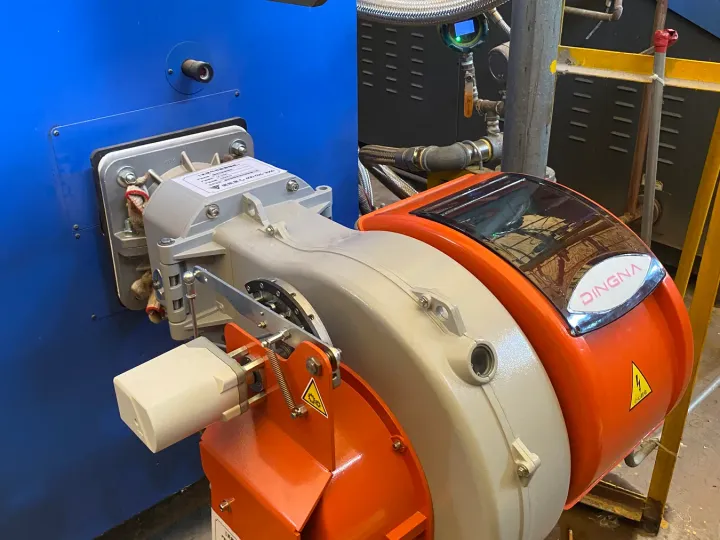
The system's hardware centres on the honeycomb catalyst plate, constructed with a high-temperature-tolerant ceramic substrate carrying a precious-metal active phase. The plate is mechanically robust, stable through repeated thermal cycling and long-lived under normal kiln operating conditions. Maintenance is straightforward: periodic visual inspection and, where activity has declined over an extended service period, a standardised catalyst rejuvenation procedure. The plate and its compatible burner are supplied as an integrated module sized to replace the existing burner in a given kiln or furnace, minimising the scope of mechanical modification during installation. For ceramic manufacturers, refractory producers and glass processors where firing energy represents a major share of production cost — and where kiln utilisation directly limits output — catalytic combustion delivers the most compelling combination of fuel savings, throughput improvement and emissions reduction in Langfu's technology portfolio.
The heart of the system — the honeycomb catalyst mesh — is the subject of a structural patent application: a double-layer Mo/Rh/Pd/Al/Cr multi-element alloy mesh with wire diameter 0.1–0.3 mm and pore size 1.4–2.5 mm, sintered at 1400℃, delivering a continuous service life of ≥ 8000 hours. In operation the flame is transparent with a faint-violet outer cone — the visual signature of deep catalytic oxidation. Field results bear out the economics: a daily-use ceramic kiln in Henan cut daily gas consumption from 2800 m³ to 2250 m³ (a 19.6% saving), equivalent to roughly 200,000 m³ of natural gas saved per year; a 1700℃ high-temperature ceramic kiln more than doubled its heat-up rate while saving around 10% gas overall; and the Jiashan Tiancheng magnetics project achieved savings above 10%. The catalytic combustion structure has cleared a formal novelty search by the MOST Southwest Information Centre (subject “A natural-gas catalytic combustion structure”, ref. J20265001241562804), which concluded that no identical prior art exists at home or abroad and the design is novel.
Key advantages
- Gas-solid catalytic deep oxidation on honeycomb catalyst surface: near-complete combustion at activation energies far below conventional ignition threshold
- Transparent flame with faint violet outer cone — energy released almost entirely as infrared radiation, visible-light losses approach zero
- Significantly more uniform cross-section temperature distribution: fewer thermal-stress defects, tighter batch consistency
- More than doubled heat-up rate in 1700℃ high-temperature ceramic kilns, compressing the firing cycle and reducing energy per batch
- Flue-gas CO near instrument detection limit, unburned hydrocarbons approach zero, NOx reduced as peak temperatures are lower
- Honeycomb catalyst plate integrates with compatible burner as a module — replaces existing burner with minimal mechanical modification
- Patent-pending catalyst structure: a double-layer Mo/Rh/Pd/Al/Cr alloy mesh, wire 0.1–0.3 mm and pore 1.4–2.5 mm, sintered at 1400℃, with a continuous service life of ≥ 8000 h and a characteristic faint-violet outer flame
- Field record: a Henan daily-use ceramic kiln cut daily gas from 2800 to 2250 m³ (19.6% saving ≈ 200,000 m³/year); the Jiashan Tiancheng magnetics application saved 10%+
- Covered by a MOST Southwest Information Centre novelty-search report — “A natural-gas catalytic combustion structure”, concluded novel (ref. J20265001241562804)
More in this category