

Solution
Metallurgy & Heat Treatment
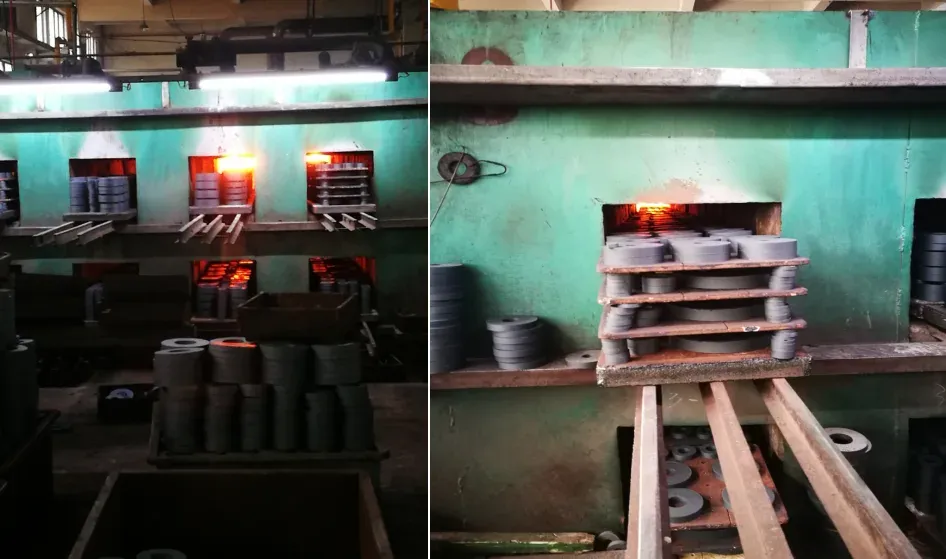
Heat-treatment furnaces, continuous annealing lines, and hot-blast stoves demand exacting temperature uniformity and fast, repeatable heat-up — even a few tens of degrees of deviation across the work zone can produce inconsistent grain structure, scatter in tensile and yield strength, and batch-to-batch quality variation that is difficult to trace or correct downstream. Simultaneously, NOx emission standards in the metallurgical sector are tightening on successive regulatory cycles, making end-of-pipe treatment an increasingly costly and uncertain compliance path. Langfu's approach pairs catalytic combustion with low-NOx staged burners to suppress thermal NOx at the point of formation, and combines this with multi-stage resonance activation that raises gas-molecule reactivity before the fuel reaches the burner. The outcome is a single integrated retrofit that simultaneously reduces gas consumption per unit of output and drives NOx emissions well below regulatory limits — without requiring separate investment in flue-gas denitrification equipment.
- Markedly faster heat-up, reducing time-to-temperature and increasing effective furnace utilisation
- Substantially improved in-furnace temperature uniformity, delivering consistent part microstructure and tighter batch-to-batch mechanical property distribution
- NOx emissions comfortably below current national limits, with ample compliance headroom that eliminates the need for supplementary denitrification equipment
- Measurable reduction in gas consumption per unit of output — at continuous production scale, annual savings are significant
Challenges
Understanding the precise pain points is the starting point for any effective retrofit.
- Slow heat-up rates and low thermal efficiency leave furnace capacity chronically underutilised
- Temperature non-uniformity across the work zone causes inconsistent metallurgical microstructure and scattered mechanical properties between parts and batches
- Rising NOx compliance costs and increasing risk of enforcement action as emission standards tighten
- Incomplete combustion at high-temperature zones creates CO exceedance risk, compounding both safety and emissions compliance concerns
- Ageing combustion systems with degraded load-following capability struggle to maintain stable temperatures across wide production load swings
- High gas consumption per unit of output erodes cost competitiveness in a commodity-sensitive sector
Our approach
We combine Langfu's proven product stack to fit your kiln type and operating conditions.
- 01Catalytic deep oxidation ensures complete fuel combustion and delivers uniform infrared radiant heat transfer across workpiece surfaces, eliminating localised overheating
- 02Low-NOx staged burners introduce fuel and combustion air in controlled sequential stages, suppressing peak flame temperature and cutting thermal NOx formation at the chemical-reaction level
- 03Multi-stage resonance activation raises gas-molecule reactivity through a molecular pre-treatment stage upstream of the burner, increasing combustion rate and completeness
- 04Detailed on-site system diagnosis and combustion benchmarking pinpoints temperature dead zones and quantifies the gap between current and optimal operating parameters
- 05Flame geometry and combustion profile customised to match furnace geometry, load type, and heat-treatment cycle requirements, optimising in-furnace gas-flow organisation
- 06Combustion air pre-heating and waste-heat recovery integrated into the retrofit to raise overall system thermal efficiency and reduce flue-gas exit losses
Outcomes
Measured on-site acceptance data is the only delivery benchmark.
- Markedly faster heat-up, reducing time-to-temperature and increasing effective furnace utilisation
- Substantially improved in-furnace temperature uniformity, delivering consistent part microstructure and tighter batch-to-batch mechanical property distribution
- NOx emissions comfortably below current national limits, with ample compliance headroom that eliminates the need for supplementary denitrification equipment
- Measurable reduction in gas consumption per unit of output — at continuous production scale, annual savings are significant
- Higher combustion stability and more precise temperature control, with a corresponding reduction in unplanned stoppages and equipment fault rate
- Retrofit investment typically recovered within two years, with sustained cost savings accumulating through the equipment life
Get a proposal
Curious how much your kiln or boiler could save?
Tell us your operating conditions and we will propose a targeted retrofit with an expected-return estimate.