

Strong-magnetic materials
·Jiashan, ZhejiangFiring-Kiln Savings, Jiashan Tiancheng Magnetics
On a strong-magnetic-materials kiln firing at 1260–1280℃, a catalytic retrofit delivered gas savings of over 10%.
Measured key metrics
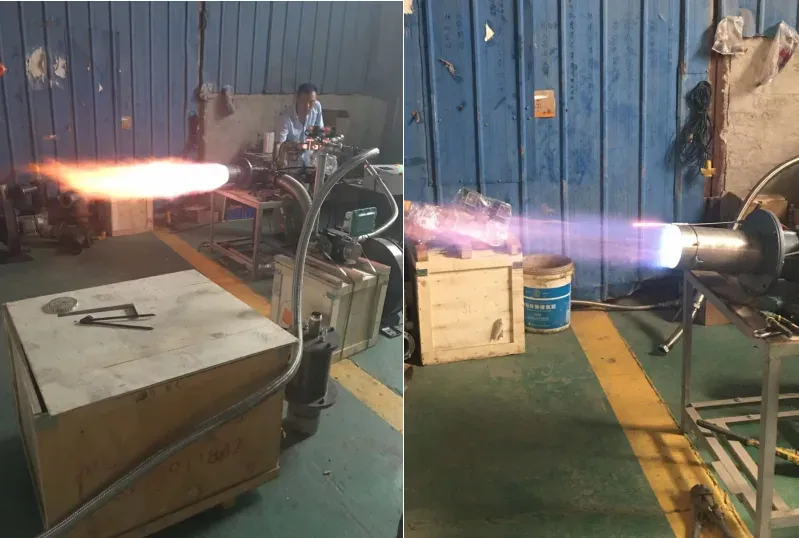
Jiashan Tiancheng Magnetics produces permanent ferrite magnetic materials at industrial scale, firing the material in kilns held to a narrow band of 1260℃ to 1280℃. The magnetic properties of ferrite — remanent flux density, coercivity, and permeability — are highly sensitive to the consistency of the firing atmosphere and the spatial uniformity of the kiln temperature. Even modest deviations from the target temperature profile can destabilise the crystalline phase structure, driving magnetic-performance drift between batches and elevating the reject rate for assembled components. This sensitivity made combustion stability a first-order process requirement, not merely a cost consideration.
Langfu partnered with a local authorised agent to deliver the project efficiently across the regional supply chain. A Langfu process engineer with experience in precision functional-materials firing was on site throughout the survey, burner selection, installation, and commissioning phases. The central challenge of the retrofit was to upgrade the combustion system to catalytic technology while preserving the exact atmosphere profile that the client's magnetic-material firing recipes required — any shift in the kiln's oxidation environment would have necessitated costly recipe re-qualification.
The homogeneous, low-temperature surface-oxidation mechanism of catalytic combustion inherently suppresses the formation of localised hot spots, which are a known failure mode of open-flame burners in narrow-temperature-band applications. Post-retrofit, the temperature distribution across the firing zone — both radially and axially — became markedly more uniform. Reduced thermal gradients stabilised the crystallographic transformation pathways in the ferrite material, improving batch-to-batch consistency of magnetic properties and reducing the frequency of thermally induced rejects.
Acceptance testing conducted by the agent confirmed gas savings exceeding 10% against the previous open-flame baseline, with stable combustion system operation meeting all process atmosphere and temperature requirements. Client feedback on both product quality and system reliability was positive. The project demonstrates both the precision-process compatibility of Langfu's catalytic combustion technology in functional-materials firing and the ability of the Langfu agent network to deliver consistent engineering outcomes across geographically dispersed customer sites.
Get a proposal
Curious how much your kiln or boiler could save?
Tell us your operating conditions and we will propose a targeted retrofit with an expected-return estimate.