

High-temperature ceramics
·Yixing, Jiangsu1700℃ Kiln Retrofit, Yixing High-Temp Ceramics
On a 1700℃ high-temperature ceramic kiln, switching to catalytic burners more than doubled the heat-up rate and cut gas use by about 10%.
Measured key metrics
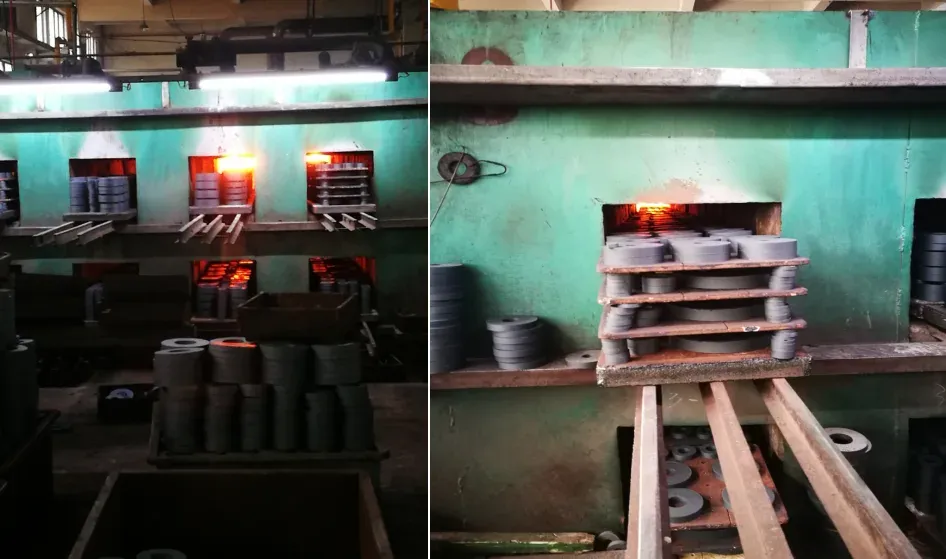
Yixing is one of China's foremost centres for advanced technical ceramics, hosting manufacturers of structural and functional ceramic components fired at temperatures that push conventional burner technology to its limits. This plant fires specialty ceramic parts at up to 1700℃ — an extreme thermal environment where conventional open-flame burners face compounding problems: poor combustion efficiency due to the difficulty of achieving complete oxidation at very high temperatures, slow heat-up rates that extend cycle times, damaging localised hot spots that accelerate refractory wear, and atmospheric inconsistency that compromises the density, microstructure, and mechanical properties of the fired product.
Langfu conducted a rigorous thermal-balance and burner-compatibility analysis specific to the 1700℃ operating envelope before committing to a retrofit specification. Once feasibility at this extreme temperature was confirmed, Langfu's resident engineers managed all on-site work: flame-shape characterisation, zone-by-zone gas-flow balancing, and systematic kiln-curve tuning across the full heat-up, soak, and cool-down cycle. The system was validated thoroughly at full temperature before the client resumed normal production.
The catalytic burners deliver a substantially higher radiant-flux output than the open-flame units they replaced. During warm-up, this concentrated infrared radiation accelerates heat absorption by the kiln lining, setters, and ware alike — the thermal mass of the refractory structure reaches soak temperature faster, compressing the heat-up phase significantly. Inside the firing chamber, the more uniform radiant-heat distribution produced by catalytic combustion improves control of the kiln atmosphere's oxidation state, which is a direct determinant of crystal-phase development and therefore of the density, strength, and functional properties of the finished ceramics.
On-site acceptance testing confirmed that the heat-up rate more than doubled relative to the previous burner configuration, with approximately 10% gas savings across the full firing cycle. Faster cycle times translate directly into higher throughput capacity from the same kiln footprint, and the combined benefit of greater output and lower fuel cost compressed the payback period substantially. The project also stands as a validated proof point for the applicability of Langfu's catalytic combustion technology at the 1700℃ extreme.
Get a proposal
Curious how much your kiln or boiler could save?
Tell us your operating conditions and we will propose a targeted retrofit with an expected-return estimate.