

Daily-use ceramics
Catalytic Retrofit, Daily-Use Ceramic Kiln
After switching to catalytic burners, the daily-use ceramic kiln averaged 19.6% gas savings — daily gas use fell from 2,800 to 2,250 m³, saving about 200,000 m³ of natural gas a year.
Measured key metrics
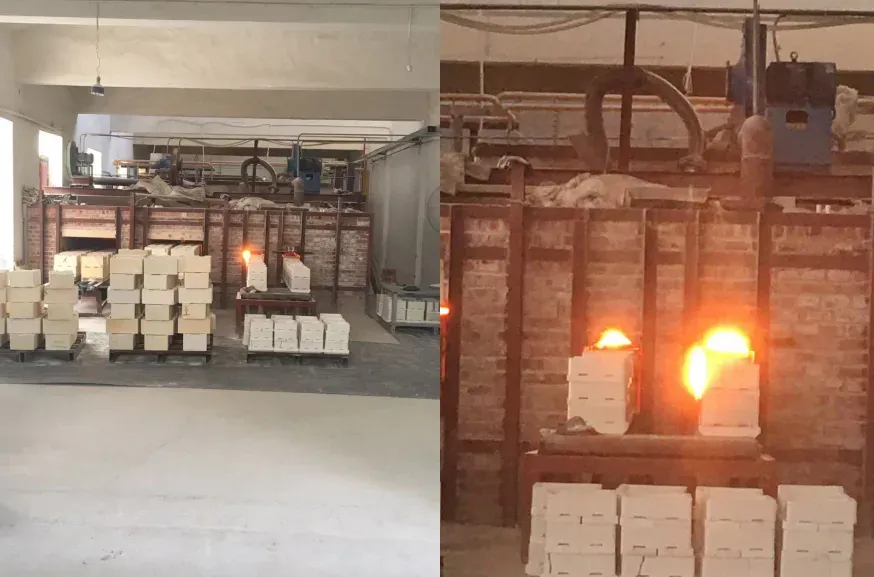
This manufacturer ran a conventional open-flame roller kiln for daily-use ceramics, consuming approximately 2,800 m³ of natural gas every day. Open-flame combustion is inherently inefficient at transferring heat to ware: the high-temperature flame relies predominantly on convection, while the more penetrating mechanism of infrared radiation is underutilised. Incomplete oxidation wastes a measurable share of the fuel's chemical energy as unburnt hydrocarbons and carbon monoxide. The combined result was stubbornly high unit energy costs, persistent temperature non-uniformity across the firing zone, and intermittent quality variation that elevated scrap rates and constrained throughput.
Langfu engineers conducted a full on-site energy audit, mapping heat-balance data and burner utilisation zone by zone across the entire kiln length, and producing a detailed temperature-distribution profile of the firing chamber. The assessment confirmed that a complete catalytic-burner replacement would deliver the highest return on investment. The retrofit was executed zone by zone during scheduled maintenance windows, allowing production to continue without interruption — a critical requirement for a plant running continuous firing schedules.
Catalytic combustion operates on a fundamentally different principle from open-flame technology. Fuel and oxidant react on the catalyst surface through a homogeneous low-temperature oxidation pathway, achieving complete combustion at temperatures well below a conventional flame. The result is a transparent, near-flameless reaction that emits heat predominantly as intense infrared radiation. This radiation penetrates deeply and uniformly into the kiln chamber, eliminating the localised hot spots characteristic of open-flame burners and producing a markedly more uniform temperature field across the full width and length of the firing zone — directly improving product consistency and reducing scrap.
Continuous metering before and after the retrofit confirmed that daily gas consumption fell from 2,800 m³ to 2,250 m³ — a verified 19.6% reduction, equivalent to 550 m³ saved per day and approximately 200,000 m³ per year. The direct fuel-cost saving is substantial in its own right. The equally significant improvement in firing-zone temperature uniformity created headroom for future throughput increases without additional fuel investment, compounding the long-term return on the retrofit.
Get a proposal
Curious how much your kiln or boiler could save?
Tell us your operating conditions and we will propose a targeted retrofit with an expected-return estimate.